



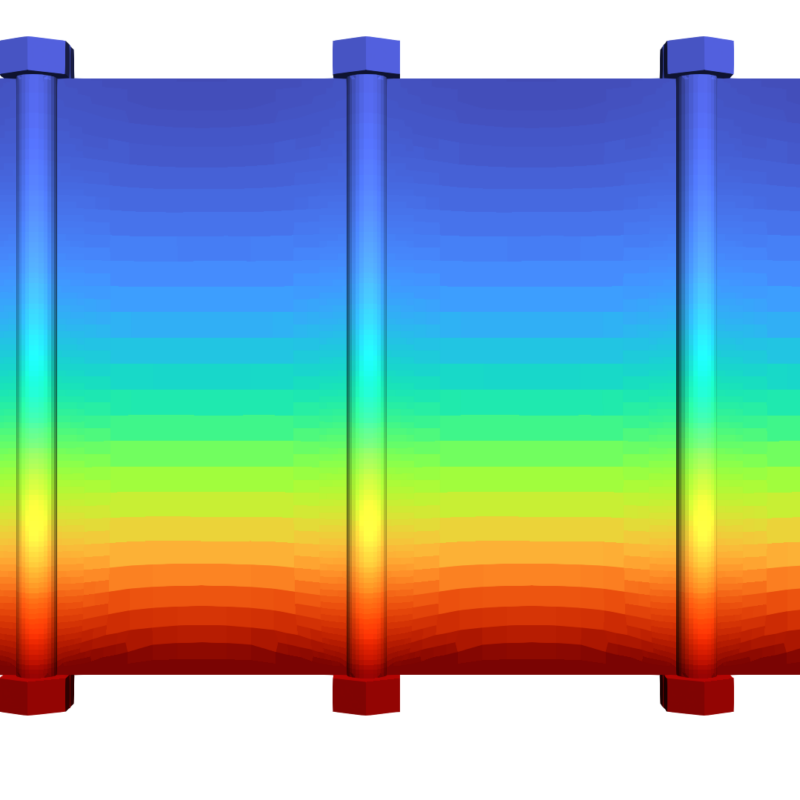
Thermal simulation concrete ceiling with steel bolts
An important aspect of fire safety engineering is compartmentation, which limits the fire spread in a building. For instance, a concrete ceiling can prevent fire spread from one floor to another.
Recently we did a project where steel bolts needed to be placed in a concrete ceiling. Concerns were raised by the project fire safety engineer about the negative impact these steel bolts might have on the compartmentation.
How we simulated it
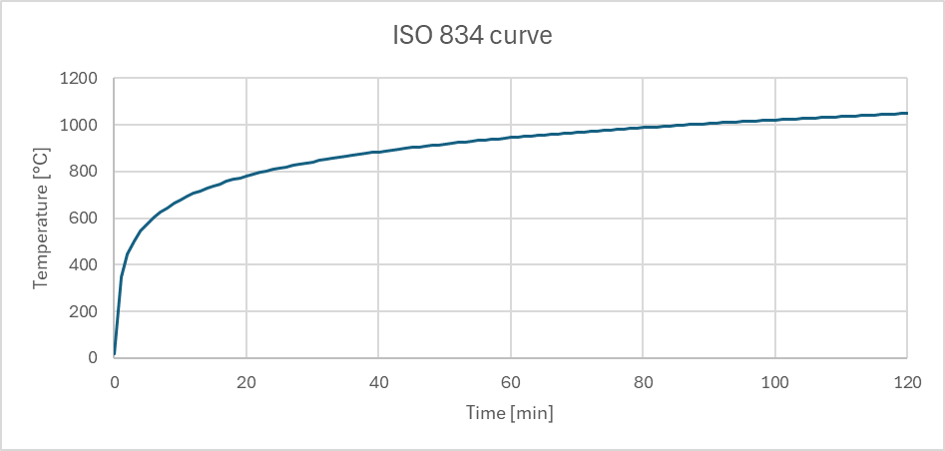
We took a took a small cross-section of the ceiling with nine steel bolts and performed a time dependent thermal simulation. On the bottom side we applied the ISO 834 temperature curve, which is a standardized curve for testing the fire resistance of materials.


The temperature of the concrete and steel bolts was calculated for a duration of 2h. The simulation results showed that after 2 h of heating the concrete floor reached a temperature of only 82.2 °C, which is typically too low to start secondary fires.
We found that although steel conducts heat much better than concrete, due to the large contact area between the bolt and concrete, the temperature difference was relatively small.
Therefore, adding the steel bolts only had a minor effect on the fire protective capabilities of the ceiling.