



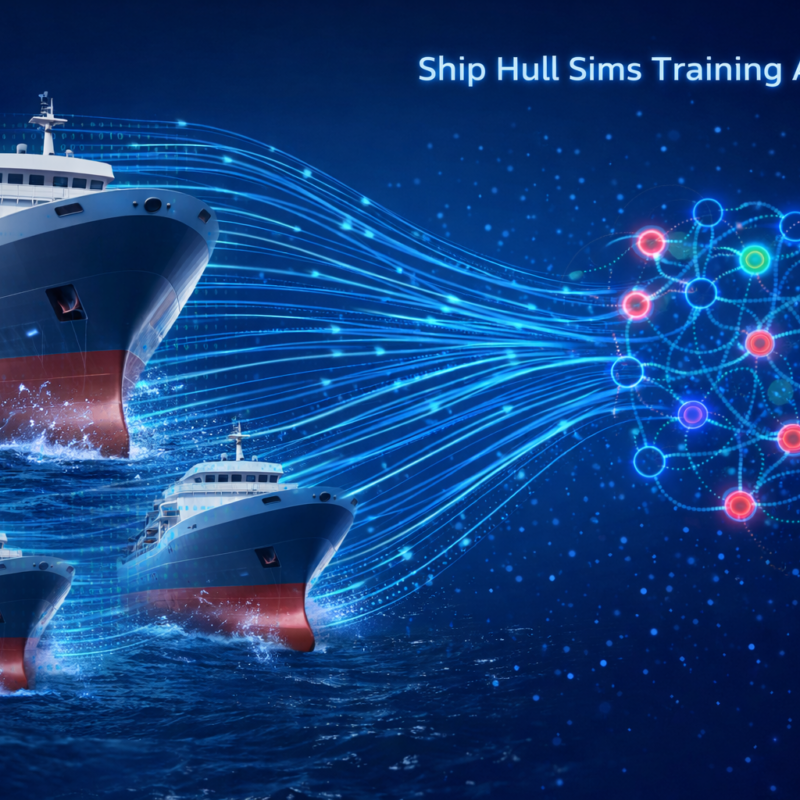
AI-based Hull Resistance Optimisation using Large-scale CFD data
Ship resistance is one of the main drivers of fuel consumption and greenhouse gas emissions. A vessel that moves through the water more efficiently requires less power, burns less fuel, and produces fewer emissions.
Traditionally, optimizing a hull form relies on computational fluid dynamics (CFD) simulations. These simulations provide detailed insight into how water flows around a ship, but they are computationally expensive and time-consuming. As a result, only a limited number of design alternatives can typically be evaluated in real-world projects.
The core idea
The AURORA project investigates whether an artificial intelligence model can learn the relationship between hull geometry and hydrodynamic resistance from a large database of CFD simulations. At the heart of the project is a dataset consisting of approximately 3,500 high-fidelity CFD simulations. This extensive simulation campaign represents one of the largest datasets specifically generated for ship resistance prediction.
The objective is ambitious but straightforward: train an AI model capable of predicting ship resistance in less than half a second while maintaining an accuracy within approximately 2–3% of a full CFD simulation.
If successful, this would allow naval architects to evaluate thousands of design variants almost instantly, enabling a level of design exploration that is currently impractical using CFD alone.
Why this matters
The potential impact of AURORA extends far beyond reducing engineering time.
A resistance reduction of just 3% may seem modest, but over the operational life of a vessel it can translate into significant fuel savings and the avoidance of thousands of tonnes of CO₂ emissions. When applied across an entire fleet, the cumulative environmental benefit becomes substantial.
By enabling rapid design optimization during the early stages of ship development, AI-driven tools could help designers make better-informed decisions long before a vessel reaches production. This contributes directly to the maritime industry's efforts to improve energy efficiency and meet increasingly stringent sustainability targets.